Imagine this: your car breaks down on the side of the road. You’ve driven it for years; it was reliable, it was yours. You call AAA, and while you’re waiting on the side of the road, someone pulls up beside you. They say they’re a car dealer. They can get you into something brand new today, cheaper than anyone in the area.
They take you to the lot and show you the most beautiful car you’ve ever seen. The paint, the wheels, the interior, all of it perfect. You sit in the driver’s seat, and the radio turns on to your favorite song. You’re in love. You buy it.
Then you’re handed the keys.
You put them in. Yet the car doesn’t move; it has no engine.
You should have taken it for a test drive. But this isn’t a car. It’s your website. And you’ve just been scammed.
I’ve seen the pitch before; it’s even been sent to me, the owner of a web design and digital marketing agency. Ironic, right? You get promised a website on the cheap, usually around $400, while being promised fast turnaround and ongoing maintenance. Most of the time, your site arrives suspiciously fast. It looks like exactly what you need for only $400.
The problem isn’t the price. It’s what nobody told you was missing.
It Started as a “Life Hack.”
While doing a survey of businesses’ websites around the Fort Lauderdale area, I encountered many websites that were near duplicates of each other, sites that screamed that they were made with AI, and even a site where you could only see the homepage, and all of the buttons led to nowhere, despite having multiple pages.
This problem is becoming systemic: 81% of retail shoppers research online before buying, meaning the first experience matters, but all you have is a website that someone rushed and never touched again.
These sites even amused me at first. Until I saw a TikTok video that genuinely angered me. It was captioned “unethical life hacks.” Unethical? How could web design be unethical? I kept watching. Their business plan: charge a business $400 for a website, offshore the work on Fiverr for $50, and charge the customer $50 a month for “maintenance” that will never be done.
I had questions. Is it a scam? Is it just a bad business? And more importantly, is this what I’ve been seeing from businesses in my area?
YouTuber Jarvis Johnson, a former software engineer, made a satirical video mocking this one, raising valid questions and criticisms that I believe every business owner should consider. Initially, Jarvis defends it: it’s essentially starting a business; arbitrage is legitimate. But then he walks into the real problem. In reality, they are selling a product that they may not even have the skills to complete. The $50 “maintenance” fee is what is truly damning, a subscription for a skill they don’t even have. Sites break, and someone who doesn’t know how to fix them can’t find a solution; the sites usually stay broken.
The problem isn’t starting a business; it’s selling a finished product you can only partially deliver.
What You Actually Got
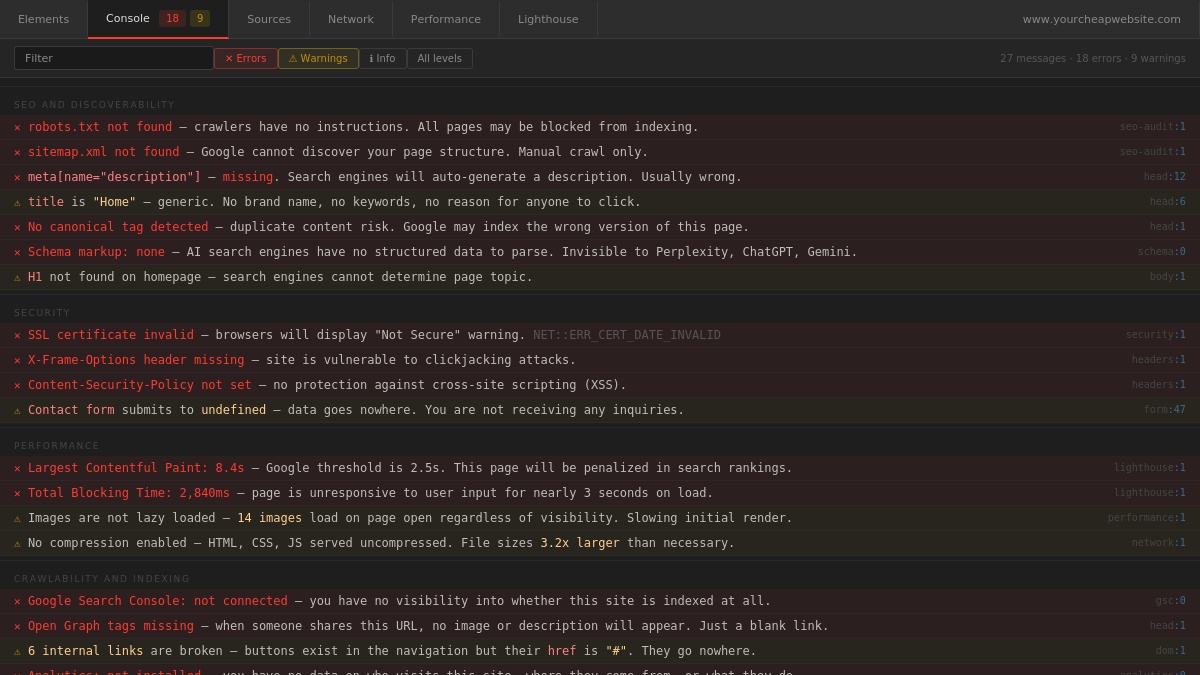
The tragic part is the backend of your site; it’s not even a nightmare; it’s nonexistent. When you aren’t given a generic Squarespace site that you could do yourself, you are given HTML documents attached to a domain. Everything is purely visual. The site has zero infrastructure. It’s just a static site with nothing attached.
Using static HTML isn’t even the problem; my own site uses it. The difference is everything alongside it. Separate files and code that set a site apart. In fact, here’s a small list of what’s missing from a $400 build:
- robots.txt
- XML sitemap submitted to Search Console
- Security headers configured correctly
- Contact forms that actually route somewhere
- JavaScript architecture that makes it behave like an experience
- CMS so the client can update their own content
- Analytics so you know if anyone’s visiting
- Core Web Vitals optimization
- Schema markup
- SSL properly configured beyond basic HTTPS
- Mobile performance optimization
- 301 redirects and canonical tags
The full list goes beyond that and includes assets that are invisible to the customer but work together to build their experience, raising their intent to buy. Someone using AI to set up a $400 website business doesn’t have the knowledge to add any of this. And AI won’t do it for you unless specifically told to, which requires knowing what is missing in the first place. To charge for this, promising a full site build is, at minimum, a misrepresentation of what you deliver.
You get sold on what seems like a deal, only to get shortchanged. You’re undiscoverable, and none of it is personalized to your business and needs. Every business is too unique to rely on basic templates or AI. For clients who need more, they’re getting underserved.
But I Paid More Than $400
This is the part that really upsets me in web design and digital marketing, and the whole reason I started Minick: some businesses pay thousands of dollars for a site that still isn’t what they need. I kept seeing businesses that had paid real money for something that looked right but couldn’t be found, couldn’t convert, and couldn’t be updated without paying someone else to change something as simple as a phone number.
The hard truth is that most web designers are not web developers; those who are rarely have a marketing background. Design makes it look nice and builds trust with the consumer. Development and infrastructure make the site function and remain secure, and marketing makes it convert.
A designer without development knowledge hands you a beautiful site that loads in six seconds and fails every Core Web Vitals check. A developer without marketing knowledge gives you something technically perfect that nobody finds and nobody converts on. You paid for a professional and got half of one.
“Most people selling websites have one of these skills; some might have two. Almost nobody at the small-business price point has all three.”
Austin Minick
Agencies solve this with teams. Most freelancers solve it by pretending the gaps don’t exist. Most business owners don’t know to ask for these things because nobody in this industry tells them they should.
Your site should be a complex ecosystem that attracts customers, builds trust, and drives action. It’s becoming increasingly hard to get noticed, which means who builds it is incredibly important.
Your site is your most important employee. Hire accordingly.

The Real Cost
You spend $400, and you get a website and liabilities. Every customer who searched for you found a competitor instead. Every month that your site sits hollow, it’s costing you everything, because it’s a shell. A shell collecting your customers’ data and card info, and nothing is protecting it.
Sadly, 80% of small businesses experienced at least one cyberattack in 2025. In fact, small businesses experience 4x more confirmed breaches than large organizations.
The main reason they are targeted is due to the lack of infrastructure and security around these sites. A major breach can cost a business hundreds of thousands of dollars and erode its customers’ trust, all because of a $400 website.
It is shocking how many small businesses expose themselves to risk online: 27% of small businesses with no cybersecurity protections collect customers’ credit card info, yet are a main target of cybercrime.
Businesses think they are getting a deal when, in reality, every customer who tried to find you couldn’t, and the door was left wide open for threats by a person who never even thought of it.
The worst part isn’t the money. It’s the business owner who paid, waited, launched, told all of their customers the site was ready, and then watched nothing happen. Who blamed themselves, or their product, or their market. Who concluded that the internet doesn’t work for their business when it should.
What It Should Have Been
Nobody sells a car without an engine and calls it a deal. But in web design, it happens every single day, because the engine is invisible and most buyers don’t know how to look for it.
You don’t need an agency, just someone who thinks like one. With how fast the internet is changing and how saturated the market is, it is more important than ever to invest in a high-quality website. But at the same time, finding a developer who knows design, development, and marketing is just as important.
Design, development, and marketing working together is genuinely rare at the small-business price point. It shouldn’t be. The difference between a webpage and a website isn’t design. It’s intention. A webpage exists. A website works for you.